Tag Archives: Busscar

ALIANZA ZEBRA ANNOUNCED A NEW COMMITMENT FOR USD1.000 MILLION FOR EBUSES IN LATIN AMERICA

PRODUCTION IS ALSO EXPECTED TO INCREASE IN THE REGION

Colombiabus newsroom – C40 Cities / William Marroquín

Important announcements have been made during these days, in the framework of the United Nations Conference on Climate Change (COP26), which have repercussions at a global level. Also, multiple commitments to accelerate the electrification of transportation in Latin America have been signed during the world meeting.

One of them of great importance has been signed by the ZEBRA Alliance, an association directed by the Climate Leadership Group, known as C40 Cities and the International Council on Clean Transportation. The alliance works to support the deployment of more than 3,000 electric buses in Latin American cities. The investor group has publicly pledged through ZEBRA to make more than $1 billion available for well-structured zero-emission bus projects in the region.

AMP Capital (Australia), Enel X (Italy), ARC Global Fund (United States), Ascendal Group (United Kingdom), Ashmore Group (United Kingdom), Copec Voltex (Chile), EDP (Brazil), John Laing (United Kingdom) ), VEMO (Mexico) and VIP Green Mobility (Switzerland), are the investors who pledged to provide financial resources to deploy electric buses in the region.

These companies have already participated in electromobility projects in Latin America, mainly in the provision of both electric buses and infrastructures of the Red (Transantiago) systems in Chile, Transmilenio in Bogotá and Metrobus in Mexico City. They have also participated as a provider of funds for the development of batteries and propellants for the electrification ecosystems of the fleets.

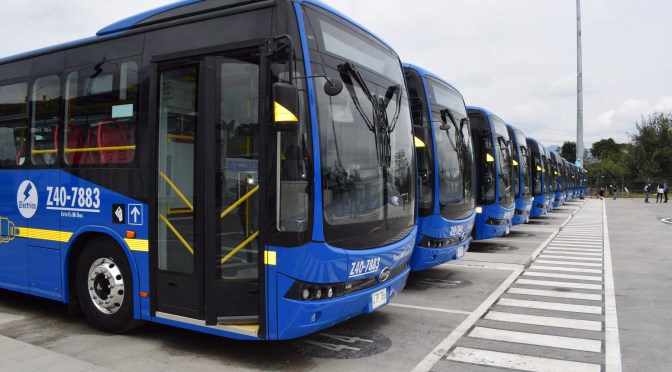
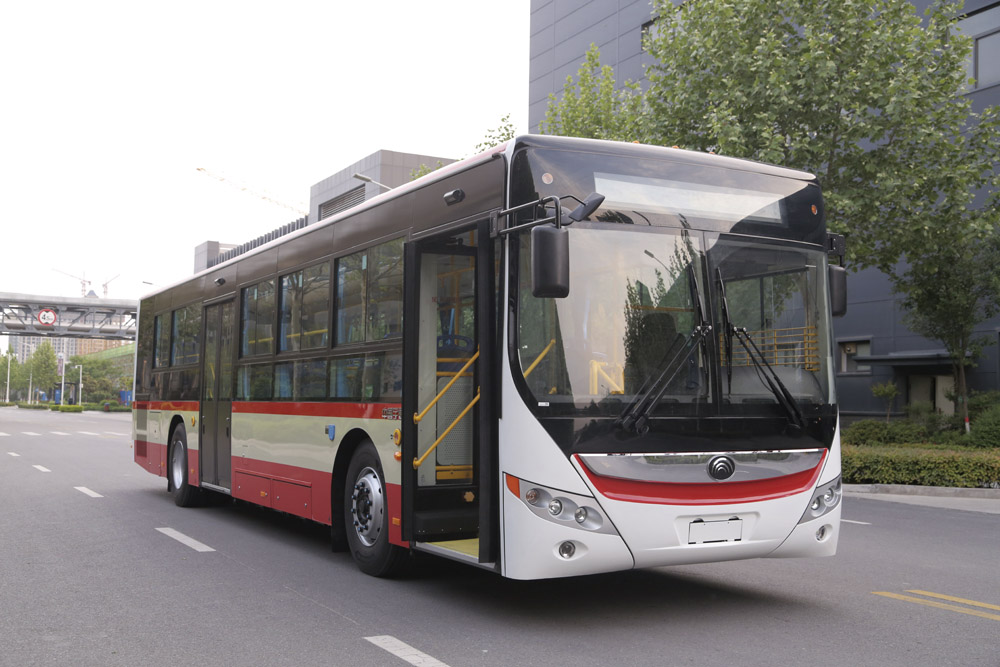
In addition to the $1 billion investor commitment, a group of bus manufacturers and distributors, including new members Volvo, Zhongtong, IUSA, Busscar and Rennorgy, have pledged to make zero-emission vehicles available commercially available in Latin America and, where possible, produced locally.

These commitments expand the group of bus manufacturers with a formal interest in the region, which already included companies such as Andes Motor, BYD, CreattiEV SAS, Foton, Higer, Sunwin, Vivipra and Yutong, all of them with a declaration signed at the end of 2020.
Innovative business models and financial mechanisms are being developed and applied to enable the large-scale deployment of electric buses, such as the separation of ownership and operation of the buses seen in Santiago and Bogotá, and the separation of ownership of the chassis of the bus and the battery in São Paulo.

Business models like these, in which manufacturers and investors play a crucial role, can help municipalities and private operators overcome lack of capital and difficult access to credit, reducing financial risks. Over time, these investments will continue to expand bus deployment
electric throughout the region.
ALIANZA ZEBRA ANUNCIÓ NUEVO COMPROMISO POR USD1.000 MILLONES PARA eBUSES EN LATINOAMÉRICA

TAMBIÉN SE ESPERA AUMENTAR LA PRODUCCIÓN EN LA REGIÓN

Redacción Colombiabus – C40 Cities / William Marroquín

Importantes anuncios se han hecho durante estos días, en el marco de la Conferencia de las Naciones Unidas sobre el Cambio Climático (COP26), que tienen repercusiones a nivel global. También, múltiples compromisos para acelerar la electrificación del transporte en Latinoamérica se han firmado durante el encuentro mundial.

Uno de ellos de gran importancia, ha sido el firmado por la Alianza ZEBRA, asociación dirigida por Grupo de Liderazgo Climático, conocido como C40 Cities y el International Council on Clean Transportation. La alianza trabaja para apoyar el despliegue de más de 3.000 buses eléctricos en las ciudades latinoamericanas. El grupo de inversores se ha comprometido públicamente a través de ZEBRA a poner a disposición más de mil millones de dólares para proyectos bien estructurados de autobuses de emisiones cero en la región.

AMP Capital (Australia), Enel X (Italia), ARC Global Fund (Estados Unidos), Ascendal Group (Reino Unido), Ashmore Group (Reino Unido), Copec Voltex (Chile), EDP (Brasil), John Laing (Reino Unido), VEMO (México) y VIP Green Mobility (Suiza), son los inversionistas que se comprometieron a aportar los recursos financieros para desplegar los buses eléctricos en la región.

Estas compañías ya han participado en proyectos de electromovilidad en Latinoamérica, prinicpalmente en la provisión tanto de autobuses eléctricos como infraestructuras de los sistemas Red (Transantiago) en Chile, Transmilenio en Bogotá y Metrobus de Ciudad de México. También han participado como proveedor de fondos para desarrollo de baterías y propulsores de los ecosistemas de electrificación de las flotas.

Además del compromiso de los inversionistas de 1.000 millones de dólares, un grupo de fabricantes y distribuidores de autobuses, entre los que se encuentran los nuevos miembros Volvo, Zhongtong, IUSA, Busscar y Rennorgy, se han comprometido a hacer que los vehículos cero emisiones estén comercialmente disponibles en América Latina y, cuando sea posible, se produzcan localmente.

Estos compromisos amplían el grupo de fabricantes de autobuses con interés formal en la región, que ya contaba con empresas como Andes Motor, BYD, CreattiEV SAS, Foton, Higer, Sunwin, Vivipra y Yutong, todas ellas con una declaración firmada a finales de 2020.

Se están desarrollando y aplicando modelos de negocio y mecanismos financieros innovadores para hacer posible el despliegue a gran escala de autobuses eléctricos, como la separación de la propiedad y la explotación de los autobuses vista en Santiago y Bogotá, y la separación de la propiedad del chasis del autobús y la batería en São Paulo.

Modelos empresariales como estos, en los que los fabricantes y los inversores desempeñan un papel crucial, pueden ayudar a los municipios y a los operadores privados a superar la falta de capital y la dificultad de acceso al crédito, reduciendo los riesgos financieros. Con el tiempo, estas inversiones seguirán ampliando el despliegue de autobuses
eléctricos en toda la región.

VOLVO BUSCA CARROCEROS PARA LOS E-BUSES QUE ESPERA VENDER EN MÉXICO

DEBEN ACOPLARSE AL CHASIS 7900 ELÉCTRICO

Redacción Colombiabus – Revista Via Libre

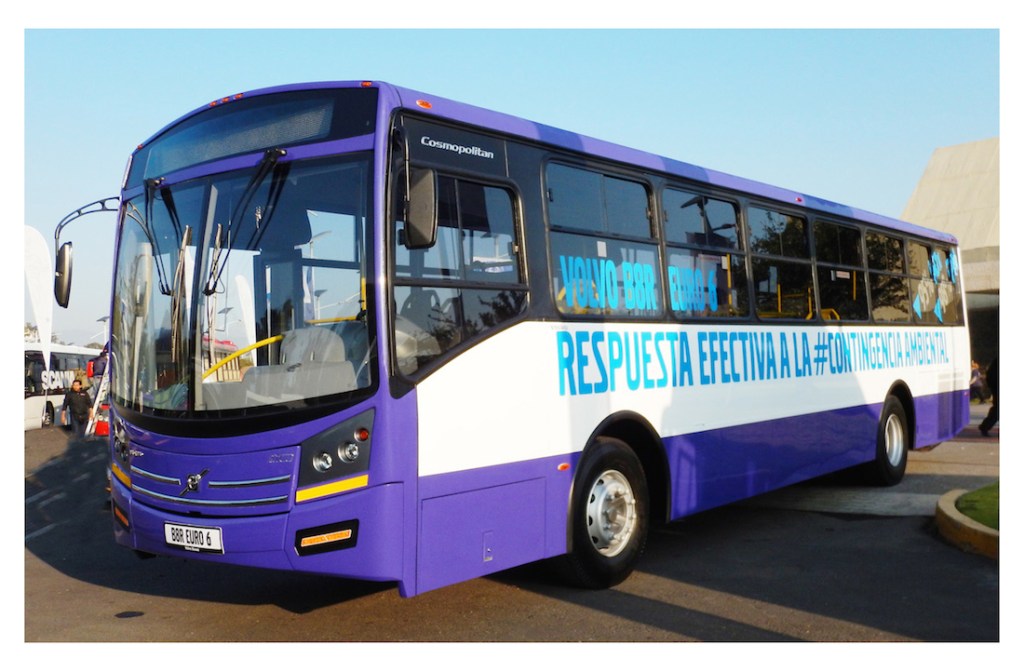
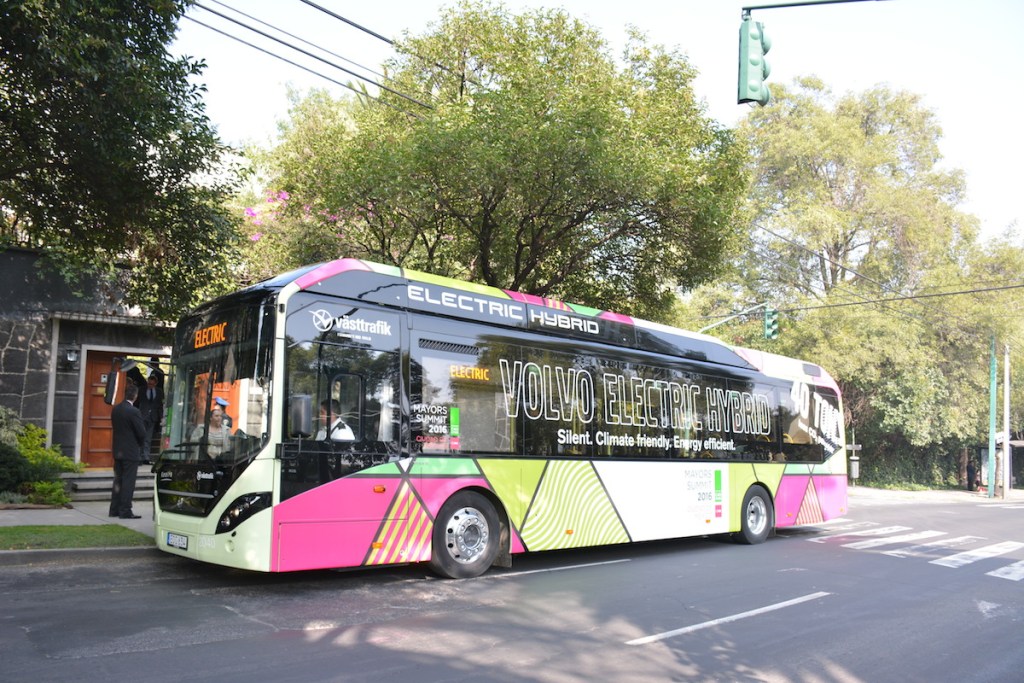
El bus eléctrico Volvo 7900, llegó a México en este 2021 para ser mucho más que un vehículo de prueba, para que los operadores de transporte urbano del país lo evalúen y obtengan información clave para viabilizar sus proyectos de electrificación del transporte. Desde que llegó, se ha discutido sobre sus posibilidades de fabricación en la planta de la compañía en Tultitlán, considerando que el actual modelo que recorre el país haciendo rutas de demostración tiene origen europeo, construido en Polonia, en la planta de Grudziadz.

Pero también se necesita tener carrocerías de desarrollo local que permitan además de dinamizar el desarrollo de la industria mexicana del bus, ofrecer versiones a precios más competitivos y tener mejores armas para enfrentar a las marcas chinas que han estado llegando al país con sus unidades integrales.

Por eso el constructor sueco busca carrocerías que se acoplen a las plataformas 7900 eléctricas, que podrían acompañar a la de origen Volvo. Esa experiencia no es nueva, puesto que en su momento los articulados 7300 contaron tanto con versiones integrales (chasis y carrocería), además de opciones a cargo tanto de AYCO como de Marcopolo.

Rafael Kisel, director general de Volvo Buses México, ha dicho varias veces que están buscando la ecuación que mejor responda a las necesidades del mercado mexicano, y si en autobuses foráneos gran parte de su éxito ha sido trabajar muy de cerca con los fabricantes de carrocerías mexicanos, en autobuses eléctricos sería una fórmula para encontrar precios más competitivos.

Marcopolo ya está al tanto de la iniciativa de Volvo y estarían dispuestos a desarrollar una versión eléctrica del Torino para integrarse con el chasís 7900, que podría ampliar la colaboración entre las marcas para desarrollar versiones articuladas y biarticuladas, que en muchos casos son el eje de la renovación de las flotas en sistemas masivos y BRT no sólo en México, sino en toda Latinoamérica, como se pudo ver en la renovación de la flota troncal de Transmilenio, en su mayoría conformada por biarticulados de 27 metros.

AYCO, también podría ser candidato, considerando que ya se han realizado trabajos con Volvo, también es capaz de acoplarse a otros chasises, lo que, al menos de entrada, podría facilitar el desarrollo de una versión apta para el 7900.

BYD HOUSES THE MARKET WITH MORE THAN 1,100 URBAN ELECTRIC BUSES IN LATIN AMERICA

RIVALS MUST WORK HARD IN LATIN MARKETS

Colombiabus newsroom – William Marroquín / eBus Radar

The eBus Radar platform is one of the organizations that promotes and monitors electromobility applied to public transport in Latin America, in charge of three functions: quantifying the CO2 emissions that electric buses have avoided, promoting data transparency and permanently monitoring the fleets of buses with this technology that operate in the region.

Monthly it publishes the statistics of the cities, the brands and the number of electric buses that are operating. It does not include the units that are awarded in different projects and that have already been ordered from the manufacturers, nor does it include those that were built but have not yet been registered. It is also important to clarify that road models are not recorded, which allows brands such as KingLong (the strongest in the region) or Sunwin, to add to the records.

In the accumulated brands that EBus Radar has been following since 2017 and taking data as of July 2021, BYD has 1,114 units sold and operating throughout the continent. An amount that has grown dramatically, especially since 2019 with the fleet electrification projects in the Red de Santiago de Chile, Transmilenio in Bogotá and Metroplus de Medellín system.

It is also a reflection of the work in many countries of several years of the Shenzhen builder, who in some of them spent several years in demonstrations, putting his products to the test in several of the most demanding urban systems in the region and betting without even making a sale a single bus, as electromobility is more grounded and the product has been better adapted to Latin America, orders are on the rise and deliveries planned for Transmilenio in the remainder of 2021 and 2022 will eventually trigger BYD’s advantage over other manufacturers of electric buses.

For a long time, trolleybuses were the majority in the region, especially in countries such as Mexico, Brazil, Ecuador, Argentina and Venezuela, which incorporated them into the fleets of their cities, since the last decades of the 20th century. The trend began to reverse in 2019, already with the positioning of other brands, the development of electromobility in cities and some incipient projects of electrification in road buses.

By 2020, the battery-powered bus fleet, generally recharged in the yard using connectors, became the majority of the electric bus fleets on the continent. This year also marked the appearance of regional projects such as the Modasa initiatives in Peru or Lucky Lion and Agrale developed in Argentina.

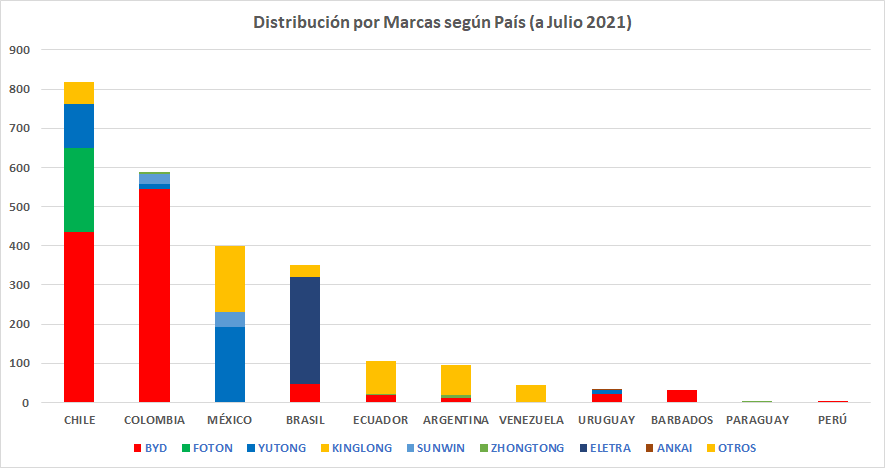
Chile, Colombia and Mexico are leaders in the participation of electric buses in the region; having 819, 588 and 400 vehicles operating and registered, respectively. The southern country also stands out for being the one with the greatest plurality of brands since, in addition to BYD as the leader, Foton, Yutong and Kinglong participate. Yutong leads in Mexico thanks to the incorporation of trolleybuses for the country’s capital, where it is also fighting for an important order on the Metrobús routes.

In Brazil, for the moment Eletra is leading the way, thanks to the incorporation of super articulated trolley chassis and 15-meter patterns that roll through São Paulo, coupled to the Millennium model bodies of the manufacturer Caio, although BYD is preparing to cut background quickly.

In the accumulated as of July 2021, eBus Radar reports that the fleet of electric city buses, deployed in Latin America, has contributed to prevent about 256,000 tons of carbon from being sent into the atmosphere. There are many brands present in the region, but little manage to be chosen, because for the operators of the region it is important that the vehicles they want to incorporate into the markets are brought in for testing and also take into account the local bodywork processes, which may even be Due to substantial transformation issues, be mandatory in various fleet modernization projects in the cities of the region.

PERU APPROVES STANDARD FOR ELECTRIC BUSES IN LIMA AND CALLAO

ALSO SPECIFIES AIR RENEWAL STANDARDS

Colombiabus newsroom – ATU / William Marroquín

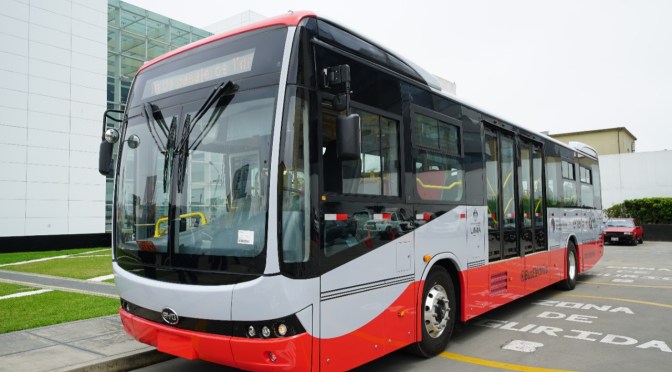
To facilitate and encourage the incorporation of zero-emission vehicles into Integrated Public Transport Systems, which are also modern and accessible to ensure inclusive mobility for the inhabitants of Lima and Callao, the Urban Transport Authority (ATU) published the Bus Standard Electrical Pattern.

Based on Directorial Resolution 02/2021, which was part of a project that was submitted for discussion, to standardize the characteristics of dimensions, capacities, weights and motor skills, the managing body of transportation in the Peruvian capital published the Directorial Resolution N° 0011-2021-ATU / DIR to be followed by public transport companies wishing to incorporate electric buses and, of course, manufacturers.

The electric buses that are incorporated for transportation in the Lima and Callao area, may have lengths of 9 and 12 meters long for single-body vehicles (midibus and standard), in addition to the articulated and bi-articulated buses that may offer 18 and 27 meters long, respectively. The capacity will start with the 40 passengers of the 9-meter midibus and will reach up to 250 of the double-articulated bus. Likewise, its battery packs must allow a range of at least 200 kilometers.

The permitted vehicle weights will start at the maximum 18,000Kg allowed for the 9-meter bus, up to 42,000Kg for the bi-articulated bus. The angles of attack, the heights from the floor to the passenger lounge, running boards, location of emergency exits are also considered. The units also have defined equipment and locations to facilitate access for people with reduced mobility (ramps, wheelchair lifts, preferential seats and for those traveling with live aid, etc.)

An important section is the renewal of the air inside the vehicles, having to be equipped with forced mechanical ventilation systems that allow fresh air to be delivered and to expel the stale at least 30 times per hour. Fans, inductors and extractors must consider a continuous work day of 14 hours. The master buses will also have an air conditioning system, as well as a biosafety system (which includes temperature gauges when entering the bus) and video surveillance cameras (to view the interior and exterior of the unit).

Speakers and signs will also be included for the transmission of variable information to the users of the service, acoustic alerts, racks for the transfer of bicycles in the front of the vehicle, among other features that will optimize the experience and improve the quality of the service in favor of the Username.

The publication of this standard is the product of a process of dialogue, learning and feedback with operators, entrepreneurs and local and international authorities. In this way, it is expected to offer the best conditions for the new buses that come to operate in the integrated transportation system for the nearly 11 million inhabitants of Lima and Callao.

PALIZA DE BYD CON MÁS DE 1.100 BUSES ELÉCTRICOS URBANOS EN LATINOAMÉRICA

RIVALES DEBERÁN TRABAJAR DURO EN LOS MERCADOS LATINOS

Redacción Colombiabus – William Marroquín / eBus Radar

La plataforma eBus Radar es una de las organizaciones que promueve y monitorea la electromovilidad aplicada al transporte público en Latinoamérica, encargándose de tres funciones: cuantificar las emisiones de CO2 que han evitado los autobuses eléctricos, promover la transparencia de datos y monitorear permanentemente las flotas de autobuses con esta tecnología que operan en la región.

Mensualmente publica las estadísticas de las ciudades, las marcas y la cantidad de autobuses eléctricos que se encuentran operando. No incluye las unidades que se encuentran adjudicadas en diferentes proyectos y que ya fueron pedidas a los fabricantes, tampoco cuenta a las que fueron construidas pero aún no han sido matriculadas. También es importante aclarar, que no se registran los modelos de carretera, lo que permite a marcas como KingLong (la más fuerte en la región) o Sunwin, sumar a los registros.

En el acumulado de marcas que EBus Radar viene siguiendo desde 2017 y tomando datos al corte de julio de 2021, BYD suma 1114 unidades vendidas y operando por todo el continente. Una cantidad que ha crecido de manera espectactular especialmente desde 2019 con los proyectos de electrificación de flota en el sistema Red de Santiago de Chile, Transmilenio en Bogotá y Metroplus de Medellín.

También es reflejo al trabajo en muchos países de varios años del constructor de Shenzhen, que en algunos de ellos estuvo por varios años en demostraciones, sometiendo sus productos a prueba en varios de los sistemas urbanos más exigentes de la región y apostando sin siquiera hacer vendido un solo autobús, en la medida que la electromovilidad está más aterrizada y el producto se ha ido adaptando mejor a Latinoamérica, los pedidos vienen en aumento y las entregas previstas para Transmilenio en lo que queda de 2021 y 2022 acabarán por disparar la ventaja de BYD sobre otras marcas fabricantes de buses eléctricos.

Fuente: EBus Radar – Gráfico: Colombiabus

Durante mucho tiempo los trolebuses fueron mayoritarios en la región, especialmente en países como México, Brasil, Ecuador, Argentina y Venezuela que los incorporaron en las flotas para sus ciudades, desde las últimas décadas del siglo 20. La tendencia comenzó a invertirse desde 2019, ya con el posicionamiento de otras marcas, el desarrollo de la electromovilidad en las ciudades y algunos proyectos incipientes de electrificación en autobuses de carretera.

Para 2020, la flota de buses movida por batería, generalmente con recargas en patio mediante conectores, pasó a ser mayoría en las flotas de buses eléctricos en el continente. También este año marcó la aparición de proyectos regionales como las iniciativas de Modasa en Perú o Lucky Lion y Agrale desarrollados en Argentina.

Chile, Colombia y México son punteros en la participación de buses eléctricos en la región; teniendo operativos y matriculados 819, 588 y 400 vehículos, respectivamente. El país austral también destaca por ser el de mayor pluralidad de marcas pues además de BYD como líder, participan Foton, Yutong y Kinglong. Yutong lidera en México gracias a la incorporación de los trolebuses para la capital del país, donde también lucha por un pedido importante en las rutas de Metrobús.

En Brasil, de momento Eletra lleva la delantera, gracias a las incorporaciones de chasises de troles del tipo super articulado y padrones de 15 metros que ruedan por Sao Paulo, acoplados a las carrocerías del modelo Millennium del constructor Caio, aunque BYD va preparándose para recortar terreno rápidamente.

En el acumulado a julio de 2021, eBus Radar informa que la flota de buses eléctricos de ciudad, desplegada en Latinoamérica, ha contribuido a evitar que se envíen a la atmósfera, cerca de 256.000 toneladas de carbono. Existen muchas marcas presentes en la región, pero pocas logran ser las elegidas, pues para los operadores de la región es importante que los vehículos que quieren incorporar en los mercados sean traidos para las pruebas y también contemplar los procesos de carrozado locales, que incluso pueden por temas de transformación sustancial, ser obligatorios en varios proyectos de modernización de flotas en las ciudades de la región.

PERÚ APRUEBA ESTÁNDAR PARA BUSES ELÉCTRICOS EN LIMA Y CALLAO

TAMBIÉN ESPECIFICA ESTÁNDARES DE RENOVACIÓN DE AIRE

Redacción Colombiabus – ATU / William Marroquín

Para facilitar e incentivar la incorporación a los Sistemas Integrados de Transporte Público de vehículos cero emisiones, que además sean modernos y accesibles para asegurar una movilización incluyente para los habitantes de Lima y Callao, la Autoridad de Transporte Urbano (ATU) publicó el Estándar de Bus Patrón Eléctrico.

Con base en la Resolución Directorial 02/2021, que hacía parte de un proyecto que fue sometido a discusión, para estandarizar las características de dimensiones, capacidades, pesos y de motricidad, el ente gestor del transporte de la capital peruana, publicó la Resolución Directoral N°0011-2021-ATU/DIR que debrán seguir las empresas de transporte público que deseen incorporar buses eléctricos y naturalmente, los fabricantes.

Los buses eléctricos que se incorporen para transporte en el área de Lima y Callao, podrán tener longitudes de 9 y 12 metros de largo para vehículos monocuerpo (midibus y padrón), además de los articulados y biarticulados que podrán ofrecer 18 y 27 metros de largo, respectivamente. La capacidad arrancará con los 40 pasajeros del midibus de 9 metros y llegará hasta los 250 del autobús con doble articulación. Asimismo, sus paquetes de baterías, deberán permitir una autonomía de por lo menos 200 kilómetros.

Los pesos vehiculares permitidos arrancarán en los 18.000Kg de máximo admitido para el autobús de 9 metros, hasta los 42.000Kg del biarticulado. Los ángulos de ataque, las alturas del suelo al salón de pasajeros, estribos, ubicación de salidas de emergencia también están contemplados. También las unidades tienen definidas los equipos y ubicaciones para facilitar el acceso de las personas en condición de movilidad reducida (rampas, elevadores para sillas de ruedas, asientos preferenciales y para quienes viajan con ayuda viva, etc.)

Un apartado importante, es la renovación del aire al interior de los vehículos, teniendo que estar equipados con sistemas de ventilación mecánica forzada que permita entregar aire fresco y expulsar el viciado por lo menos 30 veces por hora. Los ventiladores, inductores y extractores deberán considerar una jornada continua de trabajo de 14 horas. Los buses patrón contarán también con un sistema de aire acondicionado, así como con un sistema de bioseguridad (que incluye medidores de temperatura al ingresar al bus) y cámaras de video vigilancia (para visualizar el interior y exterior de la unidad). 

También se incluirán parlantes y letreros para la transmisión de información variable a los usuarios del servicio, alertas acústicas, racks para el traslado de bicicletas en la parte frontal del vehículo, entre otras particularidades que optimizarán la experiencia y mejorarán la calidad del servicio a favor del usuario.

La publicación de este estándar, es producto de un proceso de diálogo, aprendizaje y retroalimentación con operadores, empresarios y autoridades locales e internacionales. De esta forma, se espera ofrecer las mejores condiciones para los nuevos buses que lleguen a operar en el sistema integrado de transporte para los cerca de 11 millones de habitantes de Lima y Callao.

Les invitamos a consultar las dos resoluciones normativas en estos enlaces:

SE APROBÓ PRESUPUESTO PARA MANTENER OPERATIVO A TRANSMILENIO EN BOGOTÁ

PROYECTO DEBERÁ PASAR A PLENARIA DEL CONCEJO DE BOGOTÁ

Redacción Colombiabus – William Marroquín

Uno de los temas que ha generado más reacciones y preocupaciones entre los bogotanos, fue la posibilidad que Transmilenio tuviera que cerrar operaciones a partir de agosto de 2021, por las dificultaes económicas que viene atravesando el sistema, y el enorme déficit financiero que haría necesaria una adición presupuesta de 1,2 billones de pesos para evitar que la columna vertebral que moviliza a los bogotanos se mantenga activa.

Hay que tener en cuenta que la situación viene gestándose desde que empezó la pandemia, pues Transmilenio en sus componentes zonal, alimentador y troncal pasó de movilizar a cerca de 2,6 millones de usuarios diariamente, a transportar menos de 600 mil personas. Esa enorme disminución, es el principal causante del desbalance económico del sistema.

Tras ocho sesiones y más de diez fatigosas horas, la Comisión de Hacienda del Concejo de Bogotá, aprobó el proyecto presentado por la Alcaldía que incluye la adición de recursos para asegurar la continuidad de operaciones del sistema, con doce votos a favor y tres en contra, el proyecto de acuerdo 265, que agrega recursos al Fondo de Estabilización Tarifaria.

Ahora el proyecto pasará a segundo debate en la Plenaria del Concejo de Bogotá, adicionalmente, de cara al aumento de la población que ya recibió su vacuna contra la Covid-19 y manteniendo las medidas de autocuidado, se podrá inyectar mayor confianza en el sistema, para que los usuarios regresen a utilizarlo.

VOLKSWAGEN RETURNS TO Bogotá’S TRANSMILENIO WITH THE FIRST VOLKSBUS EURO VI

Colombiabus newsroom – William Marroquín / Porsche Colombia

THE SYSTEM NOW HAS 239 BUSES

Gran Américas Usme, concessionaire of the zonal component of the Transmilenio system, strengthens its fleet and becomes the first operator of mass transportation systems in Colombia to include Volkswagen Euro VI buses in its fleet. There are 28 new Volksbus 11,180 buses with the capacity to transport up to 50 passengers, with high-efficiency, low-consumption and emission diesel engines that meet the Euro VI emissions standard.

With the incorporation of these 28 new buses, Gran Américas Usme completes a fleet of 239 latest model vehicles, adding to the 211 standards it received in January 2021. The buses that are added will be key to serving routes in areas of slopes and narrow streets.

The big news is naturally the return of Volkswagen, which since 2006 has not been present in the Transmilenio system. At that time the Volksbus 17,190 and 17,230 bodied in Pereira with the legendary Busscar Urbanuss Pluss, were serving routes in the feeder service both in the North Portal and in Portal Suba, even in service until March 2021.

Another noteworthy fact is the MAN 4.8-liter displacement 4-cylinder diesel engine that complies with the Euro VI standard, delivers 180HP at 2,400 revolutions and 600Nm of torque between 1,100 and 1,850 revolutions. The transmission is a 6-speed manual provided by Eaton, ZF clutch and DANA axles, while the air brakes provided by Knorr-Bremse feature ABS + EBD.

The buses were bodied in Pereira by Busscar de Colombia, with its Optimuss model for midibus, which reinforces its alliance with Gran Américas Usme, whose 211 standards powered by natural gas also use the famous Urbanuss Pluss model. They can transport 22 seated and 28 standing passengers, with handrails and bells within reach of all occupants, an elevator for people with reduced mobility, space for wheelchairs and a preferred chair for those who need live help.

To provide comfort and help a positive travel experience through the local routes, Busscar counted on MET Group specialists who equipped the bus with technology and connectivity systems: USB ports for recharging electronic devices, Wi-Fi internet, router LED indicator to inform points of the route and cameras arranged throughout the interior.

Also, to give passengers peace of mind, the buses have recording of both the driver’s maneuvers and what happens in the passenger area and as a safety addition, the fatigue detector that alerts fleet managers about the condition who operates the vehicle.

With the entry of this fleet in the town of Usme, a total of 1,633 new buses have been linked through TransMilenio concessionaires as part of the renovation of the zonal component of the System, including the first 483 of 1,485 electric buses hired by Transmilenio. These first 28 Volkswagen Euro VI Volkbus 11,180 buses should be joined by another 139 with the same mechanical specification to continue supporting the renewal of both the zone and trunk buses of the system.

THE FIRST URBAN ELECTRIC BUS ROUTE IN MEXICO BEGINS OPERATION

 Colombiabus newsroom – William Marroquín

GUADALAJARA ADVANTAGE IN ELECTRIFICATION IN MEXICO

For a few weeks, the Mexican state of Jalisco has been announcing what will be the beginning of a revolution in urban transport in Guadalajara, as the capital of the state and the connection with other neighboring cities such as Zapopan and Tonalá. A few days ago, the articulated Mercedes-Benz units began to arrive, built in Pereira by Busscar de Colombia for the Mi Macro Periférico system and since July 4, the first urban route operated 100% with electric buses, the route C98.

38 electric units manufactured in China by Sunwin, corresponding to the SWB6868BEV model, with 20 seats and a maximum capacity of 58 passengers in a length of 8.6 meters. The vehicles have a Siemens electric motor, Dana axles, air suspension and a weight of around 13,000Kg.

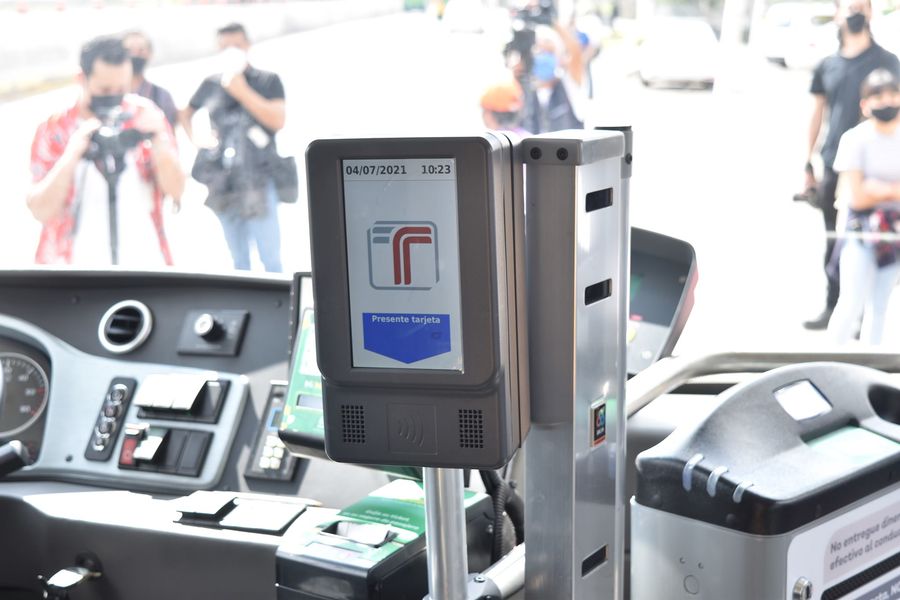
Route C98 in Guadalajara will cover the journey from the Periférico Norte station of Line 1 of Mi Tren, to the University Center of Tonalá (CuTonalá). They will be conducted by 43 women and 36 men, who for three weeks received training to become part of the personnel that will serve in these units and become familiar with the new technology. Additionally, they will have a collection system through the My Mobility card.

These buses also run in countries such as Pakistan, Taiwan, Saudi Arabia, the United Arab Emirates and Colombia. They are units that generate five times less noise than other diesel or gas buses, are more comfortable, have air conditioning and have an integrated ultraviolet disinfection system, and are low-floor for great accessibility.

Mi Transporte Eléctrico is part of the Integrated Mobility Model in the Guadalajara Metropolitan Area made up of lines 1, 2 and 3 of Mi Tren, the units of Mi Transporte, Mi Macro Calzada and soon Mi Macro Periférico, as well as the bicycle system public MiBici. This C98 route has a frequency of every 12 minutes, and the complete route from point to point takes about 2 hours and 10 minutes. Starting the first service at 5:00 and the last at 22:20

The current demand for the corridor is 12,500 passengers per day, but the system is capable of increasing the capacity to 15,000 people by connecting the route with the airport and even mobilizing 20,000 people. This is the first step to reach the goal by 2030 to renew 100% of public transport units with low-emission technology operating under new, more efficient user service schemes.